Websites for interior designers
Interior design websites that showcase your work and capture project details upfront
Clients judge a designer by the portfolio and ask about budget almost straight away. An interior design website organises your work by room and style, and asks the right questions before the first call.
The problem
What gets in the way for an interior designer
Budget comes first, and it's the hardest question
Clients want to know what a project might cost before sharing anything, and you can't say without knowing the scope.
A portfolio that doesn't help people choose
Living rooms, kitchens and offices in one long scroll make it hard for clients to find work like theirs.
Enquiries without the basics
“Can you design my flat?” arrives without the property type, size, city or budget range.
Renders and real rooms get confused
When visualisations and completed projects sit side by side unlabelled, clients can't tell which is which.
What to include
What your website should include, and why
- 01
A portfolio by room and style
Kitchens, living rooms and bedrooms, or modern, traditional and minimal: clients find the work closest to their taste.
- 02
Clear “3D render” and “completed” labels
Marking each image honestly builds trust and avoids awkward conversations later in the project.
- 03
Before-and-after pairs
The same room before and after shows your thinking better than finished shots on their own.
- 04
An enquiry that asks for a budget
A WhatsApp enquiry with prompts for property type, size, city and budget range shows early whether a project fits.
- 05
Design-only or turnkey, explained
Spelling out what each service covers, from drawings alone to full execution, tells clients what they're asking for.
- 06
Your process and typical timeline
Consultation, concept, approvals and execution described in order set expectations from the start.
Most interior designer websites are built as business websites; the other option is custom websites.
Suggested structure
The pages an interior designer website usually needs
A starting point, adjusted to your business when we plan your website.
01Home
- Featured rooms
- Services
- Enquire
02Portfolio
- By room
- By style
- Render or completed
03Services
- Design only
- Turnkey
04Process
- Stages
- Typical timeline
05Contact
- Studio
- Map
- WhatsApp enquiry
What a project enquiry should ask
These details tell you, within one message, whether a project fits your style and budget.
- Property type: apartment, villa, office or shop
- Size in square feet or BHK
- City and locality
- Rooms or spaces to design
- Budget range
- Design only or turnkey
- When the client wants to start
- Photos or a floor plan, if available
Worth checking before you publish
- Show clients' homes only with their permission, and leave out details that reveal the address.
- List material or brand partners only if the partnership is real.
This is a summary to plan your website around, not legal advice. Please confirm the rules that currently apply to you; we build the website around what you confirm.
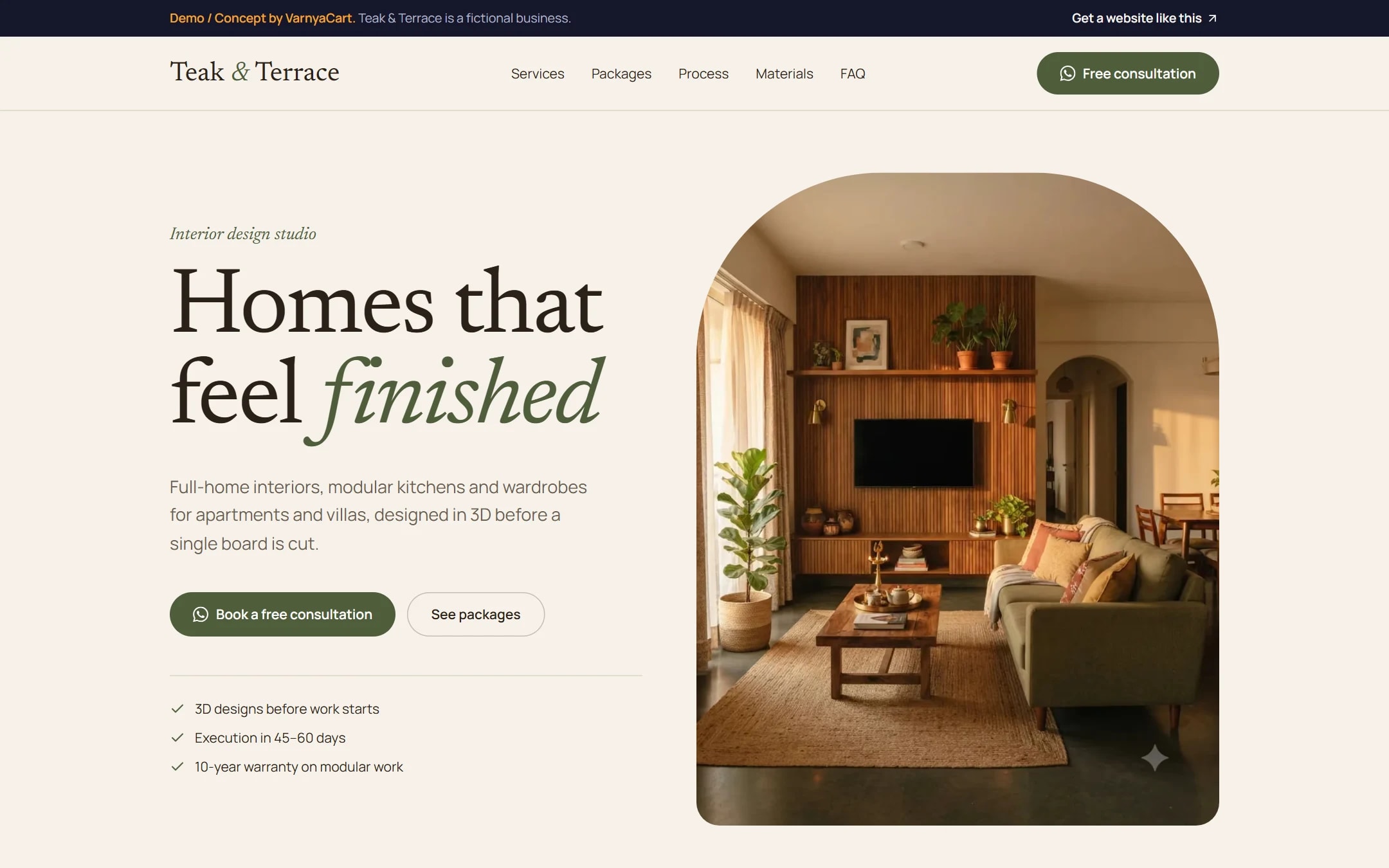
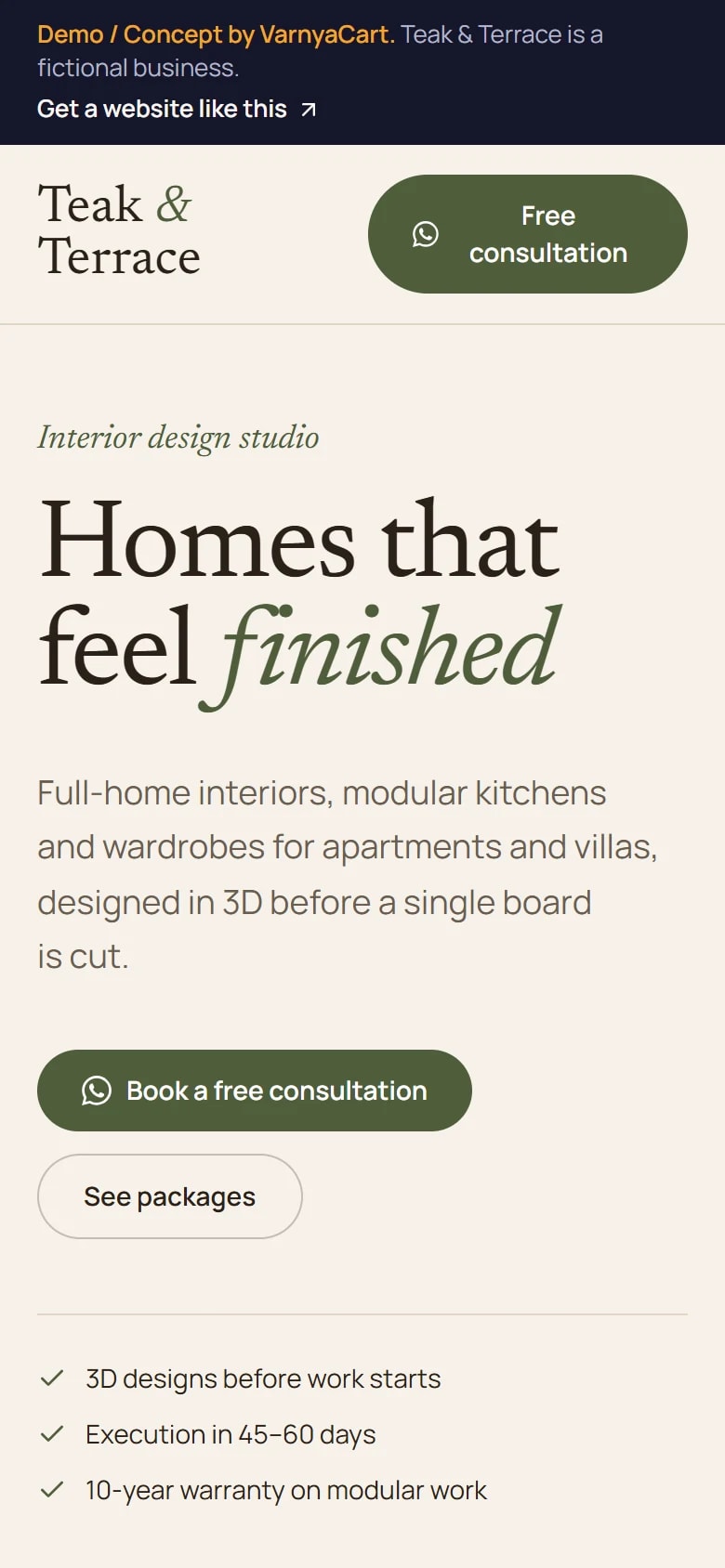
See the pattern in a working demo: Teak & Terrace
Teak & Terrace is a fictional interior design studio we built to show these ideas in practice. It isn't a client project.
How we build it
Five steps from brief to launch
- 01
Share your requirements
Tell us about your business, the pages you need and the features you want.
- 02
Plan the website
We organise your content, page structure and features.
- 03
Design and build
Your website is designed and built to the agreed requirements.
- 04
Review
You review the website and give feedback within the agreed scope.
- 05
Launch
After final checks, your website goes live.
Websites start at ₹2,999
The final price depends on the number of pages, features, integrations, custom functionality, content requirements and design complexity.
Digital marketing for interior designers
Then help more customers find you
Once your website is live, we can set up your Google Business Profile for Google Maps, post on your Instagram and Facebook, and run Google, Facebook and Instagram ads that bring enquiries to your WhatsApp.
Launch offerThe All-in-One Digital Marketing Package for ₹4,999, for the first 20 businesses. Ad budget is separate and paid directly to Google/Meta.
FAQ
Questions interior designers ask
How do I show 3D renders honestly?
Label every render as a render, and keep completed projects visibly separate. Clients appreciate knowing which rooms exist and which are designs.
Should my enquiry ask about budget?
Yes. A budget range, along with property type, size and city, tells you quickly whether a project fits, and serious clients expect the question.
One gallery or a page for each project?
A page for each significant project tells the story better: the brief, the before, the design and the result. A gallery suits smaller jobs.
Can I show photos of clients' homes?
With their permission, yes. Leave out anything that identifies where the home is, such as building names or the view from a window.
Related industries
Websites for similar businesses
Architects
Projects organised by type, galleries that stay fast, your process and registration details.
Builders & developers
A page per project with floor plans, RERA details, progress updates and site visits.
Real estate agents
Listing pages with carpet area and RERA numbers, property-specific enquiries and site visits.
Let's plan your interior designer website
Tell us about your business and what you want customers to do. We'll suggest the pages and features that fit.